Showing posts with label Puerile Delights. Show all posts

Monday, March 28, 2011

Gilbert Gottfried and the Discourse on Disaster

A Portrait of Gilbert Gottfried with a Dead Aflac Duck
on His Head by Dan Lacey (www.faithmouse.com). 
Used with permission of the artist.
As the world confronts escalating conflict and looming nuclear disaster, the Holy Prepuce has been ruminating on a more consequential matter: the Gilbert Gottfried sacking.

Why, exactly, did “tweeting” a series of earthquake / tsunami jokes get Gottfried summarily canned as the voice of AFLAC? Gottfried, after all, famously broke the ice at a post-9-11 Friar’s Club roast by recounting “The Aristocrats,” the classic improvised litany of incest, scatophilia, and a rotating menu of other horribles. So it’s not as if AFLAC was allergic to controversial material.

I suspect that Gottfried ran up against an unwritten rule of comedy: disaster jokes are not allowed to have identifiable authors.

The re-telling of disaster jokes is permissible because they are both ubiquitous and anonymous. Anyone of my generation could tell you, for example, how we knew Christa McAuliffe had dandruff, what “NASA” stands for, and why there were no showers on the Challenger. Elliot Orring’s “Jokes and the Discourse on Disaster” (1987) collects fourteen such examples, and I found no more than a handful unfamiliar twenty-five years after the Challenger explosion. Some were undoubtedly adapted from prior maritime or aviation accidents; several I have since heard re-purposed for Princess Diana or 9-11. Folklorists collect this material: Bill Ellis’s “A Model for Collecting and Interpreting World Trade Center Disaster Jokes” (October 5, 2001) identifies twelve discreet “cycles” addressing a range of events including the Kennedy assassination, the Jonestown suicides, and the Lockerbie PanAm 103 bombing.

The universality of these jokes allows us to rationalize their creation as an instinctive defense mechanism with a plausible genesis in evolutionary psychology. The impulse to detach from tragedy through humor serves as a counterbalance to our empathy and attachment, traits essential to social animals but paralyzing if unchecked in times of crisis. Laugh today about yesterday’s sabre-tooth tiger attack and you pull yourself together to hunt mastodon, eat, and live to pass along your genes.

When these jokes seem to rise from the zeitgeist, the telling itself can become the primary gag, the observational meta-joke that human beings are sick bastards who find this funny. It works because we’re all in this together: I’ve heard this one, you’ve heard that one, someone like us must have come up with this; everyone’s responsible so no one is.

But when Gottfried tweets Japan jokes as a professional comedian, there’s him and there’s us. We have no ownership, no liability as the kind of people who think this stuff up. He’s the sick bastard who finds this funny, we’re decent folk who need to take a stand against this trash.

I also think Gottfried is a victim of the Comedian On Twitter syndrome. Social media’s low-cost marketing comes at a price for comedians: fans expect free, instant funny. And so the temptation is to brain-dump ideas that might otherwise never see the light of day.

Looking through Gottfried’s tweets, and putting aside any question of taste, most of them are poorly constructed and don’t really work as jokes. A few would be salvageable with editing. One or two seem to stand on their own:

I asked a girl in Japan to have sex with me. She said “okay, but you'll have to sleep in the wet spot.”

This would be a decent mid-set gag, a supplemental laugh on an established subject. It trades on a mixing of taboos: sex and disaster, but in an understated, minimally-graphic fashion. It turns on clever incongruities of type, number, and scale. And it’s a rather sweet homage to its “sleep in the wet spot” precursor jokes, those Sexual Revolution-era meditations on negotiating casual sex and its aftermath in that brave new gender-equal world.

Here is the best of the lot:

I was talking to my Japanese real estate agent. I said “is there a school in this area.” She said “not now, but just wait."

The central equivocation is actually a stroke of genius: the ambiguity in meaning is possible only in the apocalyptic conditions of this specific moment. Delivering the punchline in the agent’s voice furthers the uncertainty: Does she intend the meaning we perceive? If so, does she take Gottfried’s question so literally as to assume a flotsam schoolhouse would meet his needs? What is her attitude toward the catastrophe if she is breezily offering its consequences as a selling point?

The fundamentals are also solid: a classic setup-line-punchline, with a strong core incongruity between mundane and extraordinary elements. I award bonus points for the dependence on visual imagination, generating dual meaning through reliance on imagery highly specific to the present moment when footage of the deluge is seared into our collective consciousness.

Indeed, the imagery invoked softens the joke by substituting masonry for human flesh. Elliot Orring points out that a defining feature of the Challenger disaster was the “shield[ing]” of “the view of that human disaster miles above the earth . . . by flame and the opaque wall of the shuttle cabin,” whereas “beyond these speakable images of flame and falling debris lay the imaginable but unspeakable images of horrific trauma and mutilation.” Many Challenger jokes operated, Orring argues, by “forc[ing] us to confront what lies behind the speakable media images that are created or manipulated for our consumption.”

The disaster in Japan was not so antiseptic: cameras covered every angle of the destruction, making blanket censorship of death impossible. Gottfried’s text in some fashion works the reverse of a Challenger joke. Instead of laying bare an obscured mayhem, it renders the devastation more palatable by focusing on a cartoonish inanimate object, without speculation as to what could lie inside.

Pre-Twitter, Gottfried might have crossed out five of his ideas, tried the rest at a small club on a Tuesday night, and wound up with the “school” bit as the one piece of usable material. It’s an excellent joke, standing alone, whose merits may render the subject matter forgivable. But by surrounding this pearl with an unvarnished barrage of lesser attempts, Gottfried came across as desperate for laughs, and his use of the subject exploitative.

I’m a tough crowd.

Monday, November 08, 2010

Post-Polling Pornucopia

It’s time for another Holy Prepuce! Research Update, where the cutting edge of academic endeavor is distilled, digested, and regurgitated for your special edification. Today’s offering: “Changes in Pornography-Seeking Behaviors Following Political Elections: An Examination of the Challenge Hypothesis,” Evolution & Human Behavior 31 (2010): 442-446. In this article, authors Patrick & Charlotte Markey answer the burning question of whether backers of successful political candidates consume more internet pornography post-election than do supporters of losing candidates.

The authors begin with some background about the “Challenge Hypothesis,” which suggests that “testosterone levels in males tend to rise during competition . . . [to] support various reproductive behaviors . . . . Interestingly, individuals do not even have to be directly involved in a competition for their testosterone levels to be affected; spectators can experience similar changes. . . .”

The effect has been documented among male supporters of winning sports teams. A recent study also “found that following the 2008 US presidential election men who voted for the winning candidate (Barack Obama) had higher testosterone levels after the election than men who voted for a losing candidate.”

Thus, the authors hypothesize, “[a] sexual behavior that might shift following the winning or losing of a competition is the seeking of visual–sexual stimulation (e.g., pornography),” and following an election we should expect to see higher rates of pornography seeking in states that backed the winning side.

As it happens, the authors tell us, pornography is custom-made for the male brain:

Men’s interest in pornography is typically attributed to men’s evolved interest in sexual variety and multiple partners. As noted [in prior research], men tend to fantasize about a place where “sex is sheer lust and physical gratification, devoid of more tender feelings and encumbering relationships, in which women are always aroused, or at least easily arousable, and ultimately are always willing.”

And where is that special man-place? Why in the magical world of porn, of course, which--as helpfully explained for those (presumably female) readers unschooled in the genre--“typically depicts women engaging in casual sex without investment.”

For those wishing to experience this “pornography” for ourselves, the authors explain that it is available in “a variety of media, ranging from books, magazines, film and video,” but advise that “however, currently, one of the most prevalent means of distributing pornography is the internet.” Readers unfamiliar with technical matters are offered the further suggestions that “[b]y simply typing a few keywords into a search engine (e.g., Google) it is extremely easy to search for pornography on the internet,” and “[f]or example, a person might type in the word ‘porn’ or ‘sex’ into the Google search engine when attempting to find pornography.”

The authors next detail their research methods, which utilize Google Trends data from the 2004, 2006, and 2008 US elections, data which can be drilled down on a state-by-state basis to determine the frequency of particular searches in a given time period:

The internet service WordTracker was used to determine which keywords individuals tend to use to search for pornography. . . by first providing WordTracker with a seed word relevant to pornography. For the current study the researchers simply used the word “porn.” WordTracker then searched the top 100 websites that rank highest on search engines for the term “porn” and extract[ed] additional keywords utilized by these sites. From this analysis, the 10 most frequently occurring, non-domain-specific, pornography keywords (e.g., “xvideos,” “boobs,” “tits,” etc.) were selected for the current study. . . . Google Trends was then utilized to determine the popularity of these pornography keywords.

And the results?

[T]he week after the 2004 presidential election Red states (i.e., the states that voted for the winner of the election) had marginally higher RSVIs [relative search volume indices] for pornography keywords than Blue states . . . . [T]he week after the 2008 presidential election Blue states (i.e., the states that voted for the winner of the election) had significantly higher RSVIs for pornography keywords than Red states . . . . [For the 2006 mid-term election], a regression analysis was conducted to examine whether or not traditionally Blue states (coded 2) had higher RSVI scores than swing states (coded 1) which had higher RSVI scores than traditionally Red states (coded 0). Consistent with the . . . hypothesis, a significant linear trend was found.

A key purpose of Holy Prepuce Research Update is to stimulate ongoing inquiry. For that reason I hope some among my readership will take up the authors’ exhortation for further research directed at some limitations of their study.

One such limitation is that backers of winning candidates

might have simply been happier and more likely to desire sex . . . [i]n other words, . . . changes in voters’ moods rather than testosterone levels [may] explain the observed changes in pornography-seeking behaviors[, a]lthough . . . previous research is somewhat mixed as to the relations between mood, interest in pornography, and masturbation.

Hence, “[i]t is hoped that future research might provide a more complete understanding of the mediators that explain why pornography-seeking behaviors tend to change following political elections.”

Another limitation is that Google Trends does not track the gender of users, and so it “would be informative for future researchers to utilize a different methodology that allows for the assessment of gender.” Nevertheless,

[g]iven the frequency that males use the internet to search for pornography . . . and the keywords used in the current study to operationally define pornography searchers (e.g., “boobs,” “tits,” etc.), it seems likely that the observed findings were driven by males.

And if I may suggest some avenues of further investigation myself: First, although revealing only “xvideos,” “boobs,” and “tits,” the article promises that “[a] complete list of the 10 keywords utilized for the current research is available from the first author.” Professor Markey may be reached through his laboratory at Villanova University, so please feel free to ask him for the remaining seven.

Second, as a resident of a blue state, I am proud to note that although red-staters displayed “marginally” higher pornography-seeking behavior after Bush’s 2004 reelection, we blue-staters delivered a “significantly” higher number of porn searches following Obama’s win in 2008. I theorize the following relationship: voting Democratic is but one manifestation of our depraved and comprehensive libertinism. Prospective testers of this hypothesis are invited out here to Gomorrah for a site visit.

Thursday, July 08, 2010

A Prisoner’s Dilemma and a Scottish Verdict: The Strange Case of Robert Wone

If I am tardy in updating Holy Prepuce!, it is because I have squandered my available Internet time obsessively following trial updates at WhoMurderedRobertWone.com. The blogosphere is saturated with theories of this crime, so rather than offering my own, I'm going to tell you three things I find extraordinary about the murder of Robert Wone and the subsequent acquittal of Joseph Price, Dylan Ward, and Victor Zaborsky on charges of obstruction and evidence tampering.

First, quite obviously, the facts: It is not every day that the General Counsel of Radio Free Asia is found stabbed to death in a million-dollar townhouse occupied by a polyamorous "throuple" and filled to the brim with S&M equipment. Nor do most killings present such Poirot-worthy puzzlers: the bloody knife that didn't match the stab wounds; the near-absence of blood; Wone's unexplained needle marks and seeming paralysis at the time of his stabbing, yet no sign in the toxicology results that he had been drugged; the discovery of Wone's own semen--and no one else's--in his rectum.

Second, the throuple's unlikely success at a variant on the classic Prisoner's Dilemma: The circumstances of Wone's death and the throuple's behavior suggested, but did not prove, that each of the three was involved in either the killing or the cover-up. One has to assume that police and prosecutors offered each man more lenient treatment if he would rat out the other two.

Each man therefore knew that staying silent meant freedom if the other two kept mum, but decades in prison if either one squealed. On these odds, a game theorist would surely advise that the optimal strategy was to talk. Yet none of the men did, even as the government escalated its game of "chicken" by prosecuting all three for obstructing justice. The throuple's mutual loyalty had great rewards--as, presumably, did their successful acts of obstruction and tampering--all were acquitted of both offenses, and none has been charged with murder.

Third, the closest approximation to the "Scottish Verdict" of "not proven" that one will likely find in an American court: As fans of Wilkie Collins or Arlen Specter well know, a Scottish jury can acquit for lack of proof beyond a reasonable doubt, but express its conclusion that the defendant most likely committed the crime by voting "not proven" rather than "not guilty."

American juries deliver verdicts of "not guilty" without explanation of their reasons, so they have no formal mechanism by which to acknowledge an acquitted defendant's likely guilt. Only in the rare circumstance that a defendant elects to be tried by a judge alone--as the throuple did in this case--does the trier of fact issue written findings in a criminal case.

Excerpts from Judge Lynn Leibovitz's Order acquitting the throuple leave little doubt that she would have found "not proven," had that verdict been available:

From the beginning, this case has been a test of the meaning of the reasonable doubt standard of proof. . . . As an initial matter, I am persuaded by the trial evidence in its totality, and I find, that the murder of Robert Wone was not committed by an intruder unknown to the defendants. . . . The government has thus presented powerful evidence to support its claim that Robert Wone's murderer was either one of the defendants, or someone known to them who was able to enter without breaking. . . . I am persuaded . . . that Mr. Price very likely tampered with and altered the murder weapon, and that he lied about his conduct in this regard to police with obstructive purpose. . . . I find that it is very likely Mr. Price altered or destroyed evidence at the scene with the specific intent to reduce its value as evidence in the imminent investigation. . . . Some of the most persuasive evidence in the record supporting the government's position is the demeanor and conduct of the defendants. From the beginning, each one of them . . . displayed a demeanor wholly at odds with what anyone would expect from an innocent person whose friend had just been murdered tragically and violently in his home. . . . It is very probable that the government's theory is correct, that even if the defendants did not participate in the murder some or all of them knew enough about the circumstances of it to provide helpful information to law enforcement and have chosen to withhold that information for reasons of their own. Nevertheless, after lengthy analysis of the evidence I conclude that the government has failed to prove beyond a reasonable doubt the essential elements . . . . My focus on the difference between "moral certainty" and "evidentiary certainty" in this case is probably cold comfort to those who loved Robert Wone and wish for some measure of peace or justice, and I am extremely sorry for this. I believe, however, that the reasonable doubt standard is essential to maintaining our criminal justice system as the fair and just system we wish it to be. I cite the wisdom of English jurist William Blackstone that it is "better that ten guilty persons escape than that one innocent suffer."

My Criminal Law professor once observed that he felt most proud to be an American the day John Hinckley was acquitted, because on that day he learned that a jury will acquit even a man who shoots the President of the United States on national television if the law says he is not responsible for his actions. And I have to say that I am similarly pleased to live in a country where a judge can be all but certain that one or more of the men before her is a murderer, yet acquit when the government has failed to prove the only crimes with which they are charged.

Having endeavored to say something intelligent about the Wone matter, I am now entitled to deliver what you've all been waiting for (and if you found this post in a Google search, what most likely contains your keywords): the Metropolitan Police Department's list of items recovered from Dylan Ward's bedroom:

racks, shackles, metal and leather collars, wrist/ankle restraints, mouth gags, black spandex hoods, assorted clamps and clips, black clothes pins, an enema kit, metal penis rings, penis vices, assorted metal chains with locks, studded penis bindings, dildos, butt plugs, nipple suction devices, a[n] electrical current/shock device, a device designed to force the wearer to drink another's urine[,] . . . . various books relating to inflicting pain on others for purposes of sexual gratification, inflicting electric shocks on others for pleasure and pain, enslaving others for sexual gratification, manuals concerning sadomasochistic practices, books dedicated to bondage practices and the like. Many of these books contained passages highlighted by the reader.

The civil trial awaits…

Friday, June 22, 2007

Custom Holy Prepuce! Google Toolbar Button / Sikh Dream in Baltimore

Folks, I know it has been a while since your last pull on the old Holy Prepuce! lever, and for that I apologize. To tide you over, I present you with a new toy and a puerile delight.

The new toy is a nifty Holy Prepuce! custom Google Toolbar button that I geeked out and created.

Just click on this link to install it. (If you don't already have Google Toolbar, the link should install that first-- the toolbar itself is a pretty cool joint.) Once the button is installed, you can click on it to visit Holy Prepuce!, you can use it to search for HP! posts containing whatever text you enter in the search box,

or you can click on the adjacent arrow to pull down a menu of the last 25 posts.

Select a post, and there you shall be.

Now, for the puerile delight, I give you this article that I found in the May 25 edition of our local "India This Week." (Just read the first sentence.)

As Mrs. P. remarked, "I don't think that's what they meant."

Wednesday, May 09, 2007

"All Women Have Periods" Redux

Update from last week's post: Reader email and the comment from Carrie have forced me to reexamine the obvious and perplexing fact that the protagonist of last week's menstruation training film appears to have Down Syndrome.
In bringing the video to my attention, reader Jennifer G. commented that "why the viewer-stand-in character is a MUCH-too-young girl with Down Syndrome is just one of the many questions this film inspires."

So I did a little digging and it turns out that there is a reason Jill looks the way she does, and that everyone in the film speaks in simple repetition. It turns out that this film, entitled All Women Have Periods, was created for the express purpose of teaching menstrual hygene to developmentally-disabled girls. And now I feel kind of like a jerk for making fun of it.

But... Jennifer G. is right, the film does still raise numerous questions. For example, why does the family have a trapezoidal bathroom? Is their universe missing the tampon particle? Why does Jill's 30ish sister Susie still live at home? Why does Susie regard the adhesive strip's peel-off backing with such contempt? According to Jill, she and her mother "were talking yesterday . . . about periods," yet today her mother explains--seemingly for the first time--what periods are, who gets them, and what to do about them. So what material did she cover yesterday? And why aren't girls with Down Syndrome allowed to know the word "vagina?"

Well, believe it or not, there exists an All Women Have Periods Study Guide. And while it does not necessarily provide guidance on the above questions, it does contain the complete screenplay, should you wish to stage a dramatic reading.

Wednesday, May 02, 2007

Period Cinema

The Holy Prepuce likes to think of this space as occasionally educational, and thus fancies himself something of an educator. As with any educator, the demands of outside life sometimes intrude on HP's curriculum development. This week is such an occasion.

But if HP's elementary school teachers taught him anything about pedagogy, it was this: lesson plans are pretty much optional so long as you can thread an 8MM Bell & Howell. If one spotted Mrs. Garvey throwing back Schlitz drafts at Pantera's Pizza of an evening, it was a good bet that the A/V cart would once more lurch its way into class the following morning.

Holy Prepuce! therefore presents you with this classic health education reel, sent in by astute reader Jennifer G. (Email subscribers: you may have to visit the blog online if your email interface does not support embeded video.)


It is comforting to know that, even as American society threatened to come apart at the seams over Vietnam and the sexual revolution, it was still possible to make a film about menstruation without once uttering the word "vagina."

Wednesday, November 22, 2006

We All Feel Like That, Reggie, Now and Then

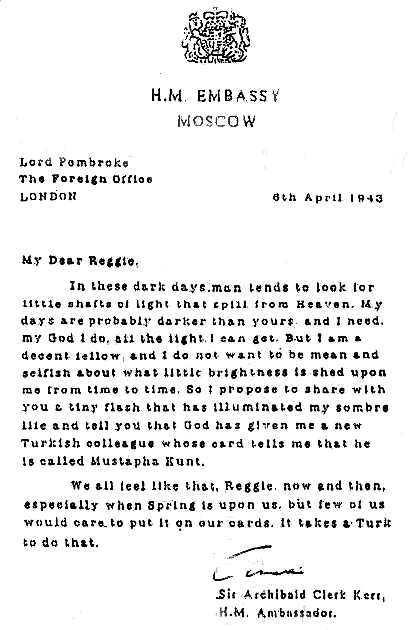
"What?" you ask, constant reader, "you went all the way to England and didn't bring me anything back? Not even a recently declassified World War II-era communiqué between Britain's ambassador to Moscow and the Foreign Office?" Soothe thyself, fair friend, I have not forgot thee. Behold:


If the image is a bit difficult to decipher, here is a transcription:

H.M. EMBASSY
MOSCOW


Lord Pembroke
The Foreign Office
LONDON

6th April 1943


My Dear Reggie,

In these dark days man tends to look for little shafts of light that spill from Heaven. My days are probably darker than yours, and I need, my God I do, all the light I can get. But I am a decent fellow, and I do not want to be mean and selfish about what little brightness is shed upon me from time to time. So I propose to share with you a tiny flash that has illuminated my sombre life and tell you that God has given me a new Turkish colleague whose card tells me that he is called Mustapha Kunt.

We all feel like that, Reggie, now and then, especially when spring is upon us, but few of us would dare to put it on our cards. It takes a Turk to do that.


Sir Archibald Clerk Kerr,
H.M. Ambassador.

Wednesday, October 25, 2006

Somali Wild Ass

Ah, the science fair. For one brief, shining moment each year, we pretend to value our nation's future and those youngsters who will spearhead its technological progress. Once it passes, of course, we get back to the serious business of kicking Consolidated District West's butt at homecoming, and restore the science geeks to their rightful places, which are approximately one tighty-whitey-legnth below the tops of their lockers.

I myself once received a blue ribbon in the local science fair for demonstrating the varying efficacies of handwashing agents, as measured by the growth of bacteria on Petri dishes I had touched following their use. A look at the organization's website suggests this modest effort likely would not prevail in today's ultracompetitive environment; top honors went this year to projects with such titles as "GO distribution in the biofluidome," "Analysis of T-DNA Insertions in the Arabidopsis DAD1 Class III Family Protein," and "The Role of Transient Receptor Potential Vanilloid 1 Channel and Metabotropic Glutamate Receptor 5 in DHPG-Induced Thermal Hypersensitivity in Vivo."

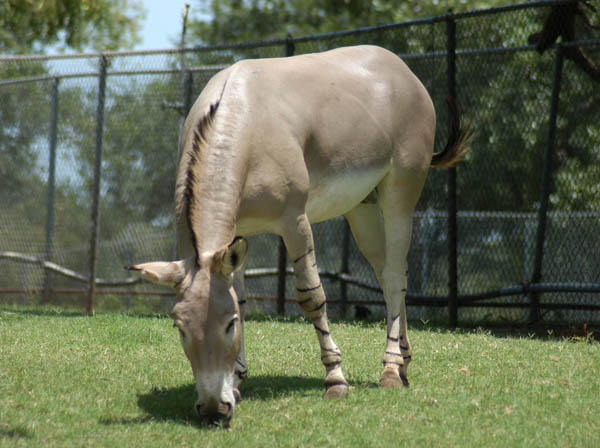
What makes me happy, however, is the simple beauty of a study conducted by one Laura Pilgram, a freshman at the Crossroads School in St. Louis. Miss Pilgram set out to answer the vital question of whether zoo visitors are uncomfortable speaking aloud the words "Somali Wild Ass." Utilizing the nearby zebra enclosure as a control, Miss Pilgram observed parents' reactions on approaching the Somali Wild Ass pen. While all 50 subjects spoke the word "zebra" to their children, only 8 seemed willing to utter the common name of Equus africanus somaliensis. One mother explained that she feared her 19 month-old daughter would "pick up" the word ass: "It's short, and it has three letters, I don't want her taking it to church."

Pilgram is concerned that the word ass--which she points out is only rude as a corruption of arse--dissuades visitors from learning important facts about the Somali Wild Ass. For instance, one might not discover that this Ass is one of three subspecies of African Wild Ass, that this six hundred pound Ass is the smallest of all Wild Ass species, or that the Ass has a highly flexible social structure, ranging from solitary Asses to Ass herds of up to fifty Asses, some herds composed of only male Asses, some of only female Asses, and some of both male Asses and female Asses.

Strong work, young Laura, strong work. You have a bright future ahead of you. If only we could say the same for the critically endangered Somali Wild Ass.

Tuesday, June 06, 2006